Fashion Writing
Academic Essays
Graduate Coursework, MA Fashion Studies, Parsons School of Design
The “Time Capsules” of Amanda Tabet: Feminist Expression and Cultural Meanings Within Fashion Design
Excerpt: For Amanda Tabet, clothing serves as a vessel of memory, often describing garments as “time capsules” that materialize emotions and experiences. Describing herself as “deeply nostalgic and classically sentimental,” Tabet understands garments as “heirlooms” embedded with personal history. Tabet’s work and design process resonate with Kopytoff’s (1986) framework of the Cultural Biography of Things, viewing garments and fashion as culturally shaped and emotionally charged, thereby encapsulating personal history. Memory and nostalgia play a foundational role in her design process. She often finds herself gravitating toward 1960s silhouettes, with an emphasis on colour blocking and boxy fits, as well as other aesthetic choices rooted in emotional resonance and nostalgia. Small design details, such as buttons, are a prominent feature of her work, evoking whimsy and childhood memories.
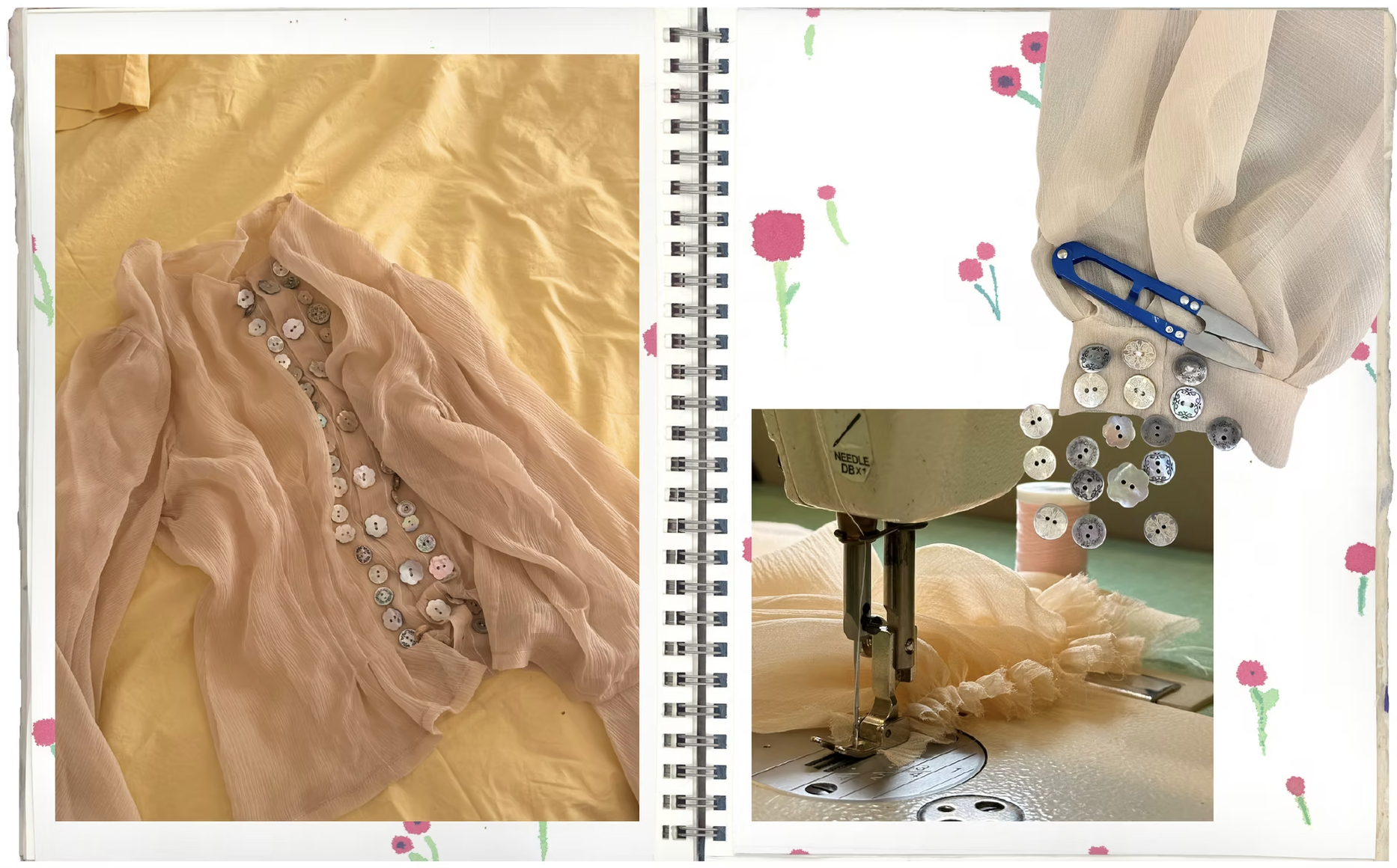
The use of buttons in Amanda Tabet’s designs to evoke whimsy and childhood memories (Tabet, 2025).
Depop: Valuation Practices of Young Adult Users and the Sustainability of Digital Second-Hand Fashion
Excerpt: Northern Canadian Indigenous approaches to material use offer sustainability models grounded in relationships with land, responsible harvesting, and resource management. Given resource scarcity in Northern communities, which has long fostered deep traditions of mending, repurposing, and careful material use, the show reflected this reality in its costume design. Overall, North of North visualizes what Fletcher (2010) describes as sustainable practices – designing for longevity, valuing repair, and minimizing waste. In one of Siaja’s dream scenes, she is wearing a dress and accessories that blend Inuit and Regency-era styles. When asked how Hanson created the Qaurutik copper headpiece out of salvaged electrical wire, he responded, “It’s the Inuk way of doing things, using what you have and not throwing things away” (Boutsalis, 2025). These details demonstrate that North of North emphasizes Inuit fashion as an inherently sustainable practice rooted in resourcefulness.
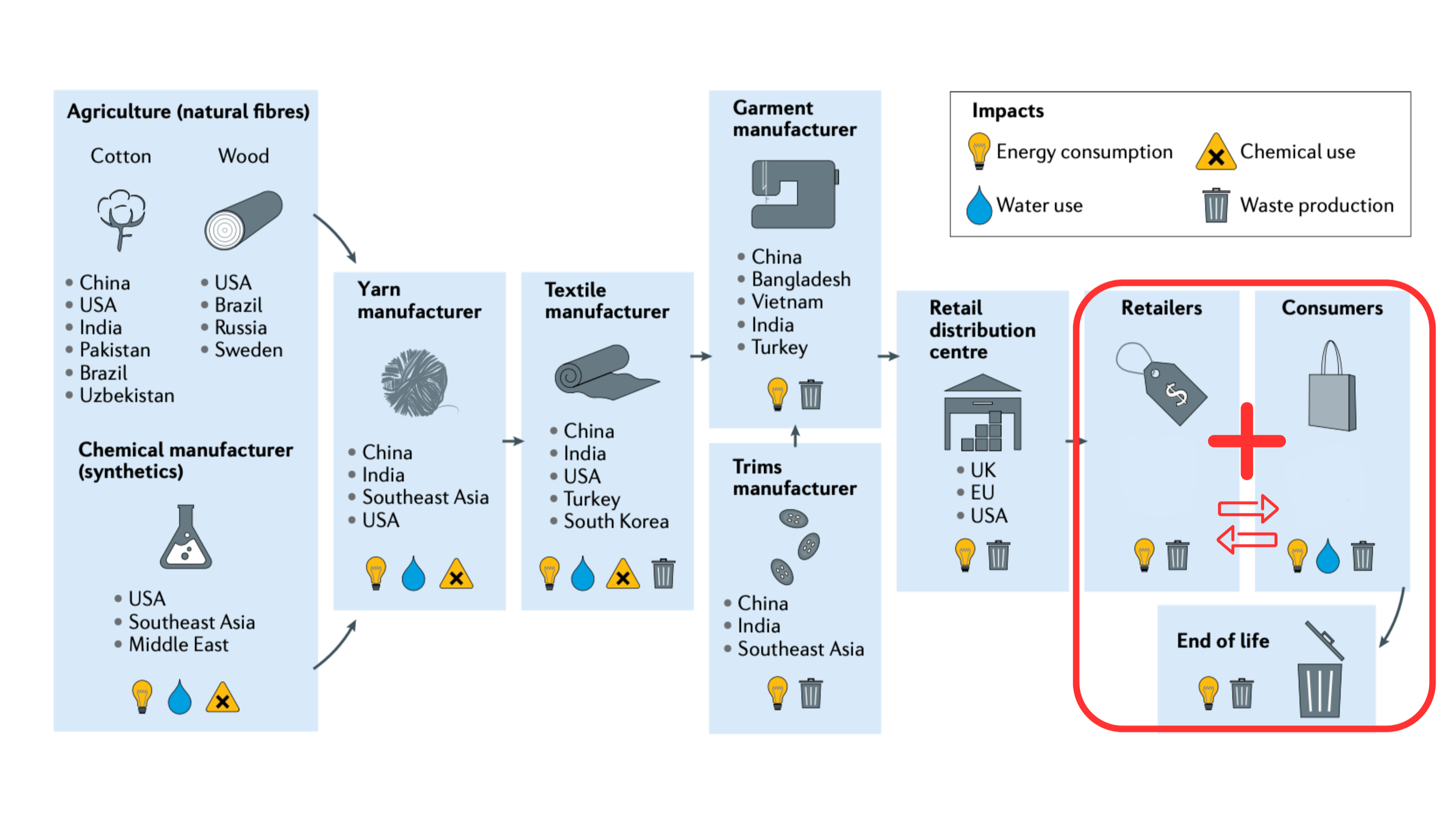
Garment-manufacturing supply chain (Niinimäki et al., 2020, 191).
Canadian Indigenous Fashion: Exploring the Possibilities and Limits of Cultural Visibility Through North of North
Excerpt: Niinimäki et al. (2020, 198) argue that fast fashion’s linear “take-make-dispose” model is ecologically unsustainable, as the industry’s overproduction – estimated at 80 billion garments annually (Thomas, 2019) – cannot be offset only by increased resale. Instead, a transition toward circular models of “efficiency, recycling, and reuse” is required (Niinimäki et al., 2020, 198), with overall consumption reductions as the primary focus. Niinimäki et al. (2020, 191) provide a graphic illustrating the key stages of the fashion supply chain, along with the geographic location and broad-scale environmental impacts (energy consumption, water use, waste production, and chemical use) for each stage. Despite being created to outline the lifecycle of fast fashion, the graphic remains relevant in the case of Depop, particularly given shifts in meaning and flow across the retail, consumer, and end-of-life sections. The graphic has been edited in red to emphasize the environmental effects occurring in the last three stages of the fashion supply chain. On Depop, users act as both retailers and consumers, photographing, pricing, and listing items themselves or purchasing items from other users.

Siaja wearing a dress and accessories that blend Inuit and Regency-era styles, including a Qaurutik copper headpiece made from salvaged electrical wire (Boutsalis, 2025).
The Analysis of Ghana’s Kantamanto Market as a Fashion “Sacrifice Zone”
Excerpt: The concept of a fashion “sacrifice zone” was coined by Sandra Niessen in her article “Fashion, Its Sacrifice Zone, and Sustainability” in 2020. Niessen (2020) defines sacrifice zones as “physical locations that are designated expendable for the sake of economic activity,” resulting in both ecocide and sustained colonial racism as the environment and associated cultures or populations are destroyed.
The Kantamanto Market in Ghana is an example of a fashion sacrifice zone. In terms of environmental devastation, tonnes of unsold clothes, often synthetic, fill landscapes, clog waterways, or are incinerated – polluting the environment in various ways. Regarding economic impacts, although the markets provide livelihoods for workers in Kantamanto, the high-volume, low-quality secondhand garments disadvantage local vendors and industries. The Kantamanto Market illustrates how the global secondhand clothing trade redistributes the environmental burden of fashion consumption from the Global North to the Global South. While often framed as a sustainable solution to textile waste, the system instead reveals the structural inequalities embedded within the global fashion economy.
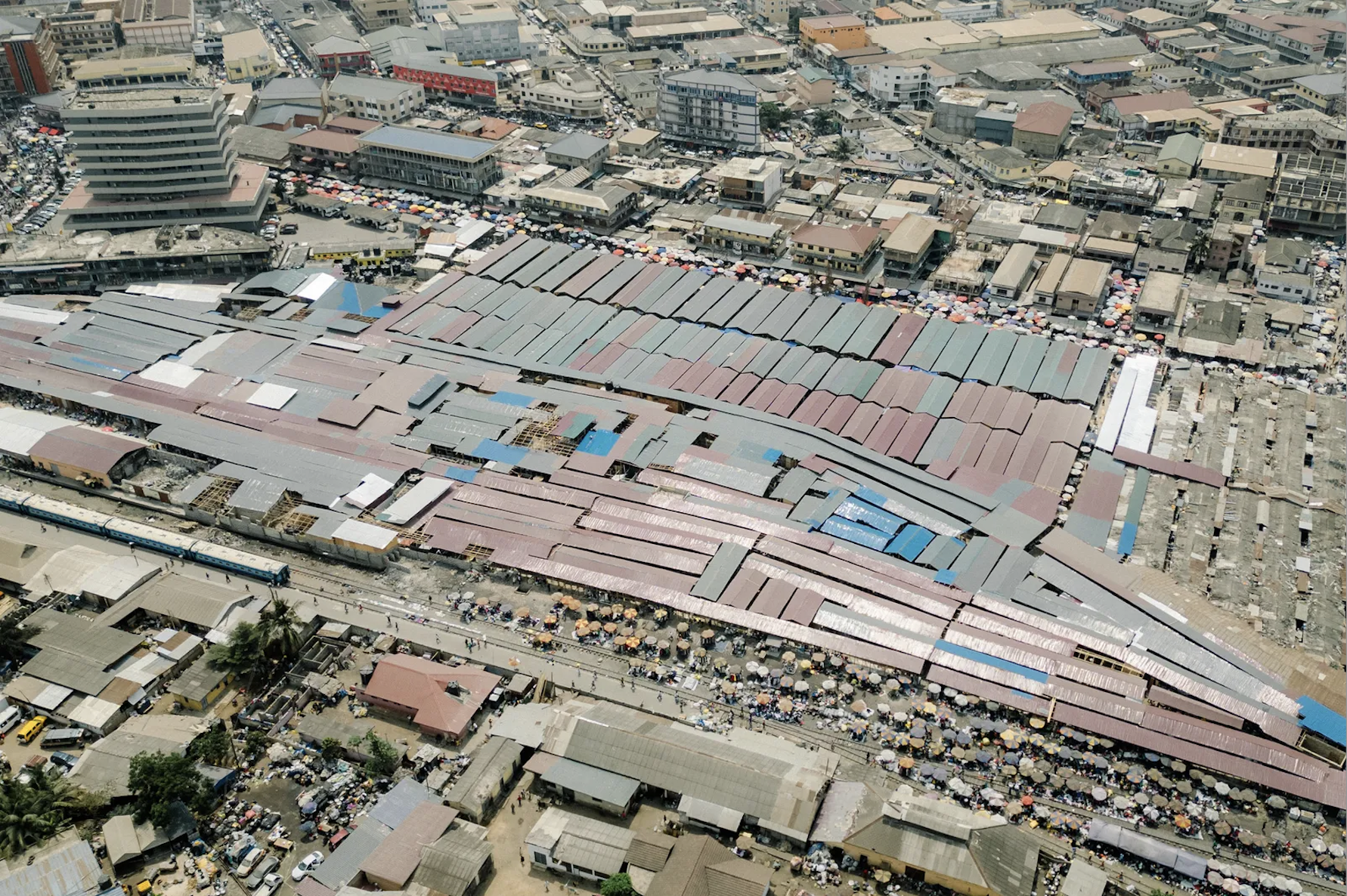
Kantamanto Market From Above (Vogue, 2025).